


27.11.2023
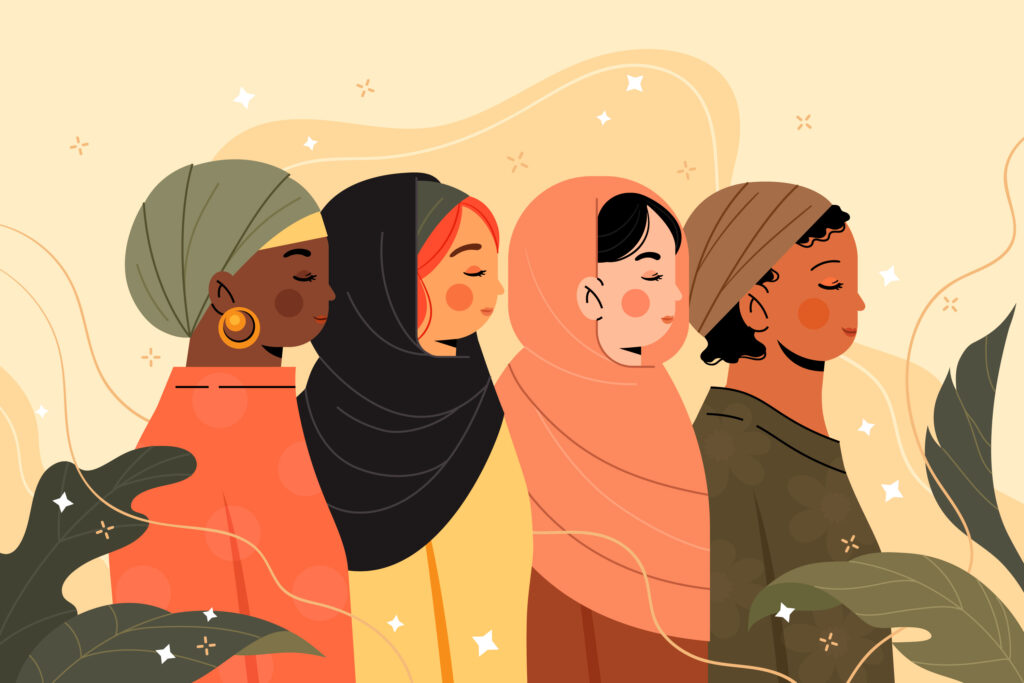
The issue of women’s rights in Islam has been a contentious area of discussions and intense debates both in the Muslim world and in the West. The two dominant mainstream narratives have victimized Muslim women, though in different ways. On one hand, many Muslims and Muslim governments appropriate Islamic text to justify discrimination against women and to impose social and legal restrictions on women’s rights and freedoms. On the other hand, Western islamophobic neo-orientalists use these popular yet traditional misogynistic readings of Islam to support their xenophobic claims against Islam and Muslims.
Five unknown and misunderstood issues about women in Islam
1. Patriarchal traditions colored the early and dominant interpretations of the Qur’an
The foundations of Islamic law are based on the Quran and also utilize the Sunnah (hadith and the Prophet's example) for clarification. When these sources don't address certain issues, Muslim scholars resort to Ijtihad – the science of interpretation and rule-making. Various Ijtihads may differ in opinions, but it's acceptable if grounded in religious and linguistic knowledge and carried out in good faith.
Dr. Aziza al-Hibri, an honorary law professor at the University of Richmond and a leading scholar in Islamic law and human rights, points out that Islamic law and Ijtihad schools are influenced by patriarchal traditions. These assumptions have become deeply rooted in Ijtihad and Islamic law, mistakenly considered derivatives from the Quran. The liberal use of Ijtihad was limited by authoritarian political institutions aiming to preserve their interests, resulting in patriarchal structures in Ijtihad.
Muslim jurists are products of societies where the patriarchal notion of male superiority influences Quran interpretation. These Ijtihads reflect their times and require reevaluation. As Dr. Asma Lamrabet, a prominent figure in the feminist review of Islamic texts, states, Islamic thought must evolve, distinguishing spiritual messages from interpretations that freeze the text and suppress its true message.
2. Alternative non-patriarchal interpretations of the Qur’an do exist
The context of Islamic scholars suggests that the Quran clearly defines the principle of equality for all people. In the Quran (49:13), God created men and women from one soul, considering them equal and ranking them based on moral choices. However, certain verses may appear to support male dominance. For example, the 34th verse of Surah An-Nisa’ is often interpreted as endorsing male superiority, but alternative interpretations exist.
Specific cases like this require considering the context. For instance, the 34th verse of Surah An-Nisa’ can be understood as describing a specific situation of that time where men are "protectors and maintainers," considering their ability to provide support. Such specific verses should not be generalized to all times and societal conditions. Alternative interpretations exist. For example, the 34th verse of Surah An-Nisa’ could be seen as an exception, and the general principle of equality should be considered the norm.
For example, the principles of Islamic law-gradualism, consultation (shura), and the absence of coercion—can contribute to gradual changes in the status of women. Eventually, Islamic principles can serve as a foundation for revisiting patriarchal norms and reinstating Ijtihad. Importantly, these changes should originate within the Islamic world, ensuring active participation of Muslim women in reforms and reinterpreting the Quran to justify historical biases. The process of emancipation should be rooted in the Quran's own principles, as secular approaches, even feminist ones, may not be accepted in a religious environment. Such an internal approach is crucial as Muslim believers feel a connection to their religion, making changes emerging from within more acceptable. External influences, especially measures perceived as interference, may evoke a negative reaction.
3. Context Matters
Main interpretations of the Quran that place men above women are subjective interpretations, influenced by historical and geopolitical conditions. Quranic verses should be considered in the context of their revelation as they reflect specific circumstances.
For example, Surah Al-Baqarah 282, often cited to argue male superiority, in the context of a business deal states, "When you contract a debt for a fixed period, write it down, and let a scribe write it between you justly... and bring to witness two witnesses from among your men. If there are not two men, then one man and two women from those whom you choose as witnesses." Taken out of context, this verse may seem like an argument for the inequality of women's testimony. However, considering the business deal scenario and the fact that women at that time were not involved or knowledgeable in business matters, this verse should not be seen as evidence of gender inequality. In fact, the second Caliph, Umar ibn Khattab, appointed a woman to manage market affairs in Medina.
Such interpretations should be considered in the context of their time and not applied universally to different contexts. Islamic principles also support changes in Islamic law through Ijtihad, discussed through the principles of rationality and public interest. Therefore, it is essential to consider Ijtihad and reforms within the Islamic world, where believers play an active role in reinterpreting the Quran and correcting historical assumptions that have influenced its understanding.
4. Muslim women’s rights are attainable through Islam
According to Dr. al-Hibri, the Islamic philosophy of change embraces gradual change, and is linked to the principle of shura where societal affairs are conducted in consultation. The Islamic philosophy of change is also linked to the important Qur’anic principle of no compulsion in the matters of faith. Gradualism, shura, and aversion to coercion are important Islamic principles that are most appropriate to advance the rights of Muslim women. Gradual stable change to the status and rights of Muslim women is therefore achievable through Islam. Two of the agreed upon principles of Islamic law: rationality (‘illah; when a reason for a law disappears, so must the law) and public interest (maslahah; Islamic laws must serve the public interests, including those of women) are important foundations for revising patriarchal laws and re-engaging in ijtihad. As such, Muslim women’s rights can be attained through these Islamic jurisprudential principles and requirements.
5. Liberation must come from within the Islamic domainAs al-Hibri points out, Muslims women tend to be religious, and would not react well to a western feminist perspective that is imposed upon them, therefore secular approaches to women’s rights are not likely to ‘liberate’ Muslim women because people of faith will continue to want to follow their perception of the Divine Will. In addition, many scholars argue that there is no universal model of gender equality (‘one size fits all’), and the West should not keep a monopoly on the topographies of modernity and truth.
In this context, liberation and change must come from within the Islamic sphere, where Muslim women have a proactive and autonomous role in reform, re-reading of the Qur’an, and revealing the historical prejudices that colored the understanding of the Qur’anic message. In an environment of religious devotion, liberation must be rooted in the roots of the Qur’an.
Join our mailing list