


27.11.2023
Ukraine has made significant progress in advancing women’s rights since its independence. Still, more remains to be done, especially given the profoundly negative impact of the full-scale russian invasion. If Ukraine is to emerge from the post-war rebuilding process with an improved focus on equality for women and various marginalized communities, it is crucial that these groups not only have a say but play a leading rule in decision-making processes regarding the country’s recovery.
Image by jcomp on Freepik
It is important to acknowledge that Ukraine was among the first post-Soviet countries to decriminalize homosexuality and then to swiftly implement laws to guarantee equal rights and opportunities for women and men as well as laws on domestic violence and trafficking. Yet, for a long time, Ukraine has presented a paradoxical case for scholars and policymakers alike: despite having one of the most progressive legislations on gender equality in the post-Soviet region, there continued to be glaring cases of discrimination of women and LGBTQIA+ people as well as severe underrepresentation of women in politics, economy, and other spheres of social life.
“Gender” as a term to describe identity faced some resistance in Ukraine. This resistance was especially prominent in the mid-2010s. It was prompted by substantial changes in the country’s political situation that stemmed from post Euromaidan economic situation and the occupation of Crimea and the Donbas region by russia that altogether led to the emergence of anti-gender rhetoric. Similarly, despite the LGBTQIA+ support for political changes in Ukraine and their presence at the Euromaidan protests, the years immediately following the Euromaidan saw the spread of homophobic and transphobic rhetoric among right-wing political groups.
Still, Ukraine has significantly improved the situation of women and has shown notable progress in promoting gender equality, especially if one is to compare the current indices to the indices it showed in the early 2010s or even the 1990s. The Global Gender Gap Report is compiled by the World Economic Forum and measures gender equality and gender gaps in four categories (economic participation and opportunity, educational attainment, health and survival, and political empowerment). According to the Global Gender Gap Report 2023, Ukraine is ranked 66th among 146 countries in the world. This report is the longest-standing index that tracks advancement of gender equality worldwide since 2006.
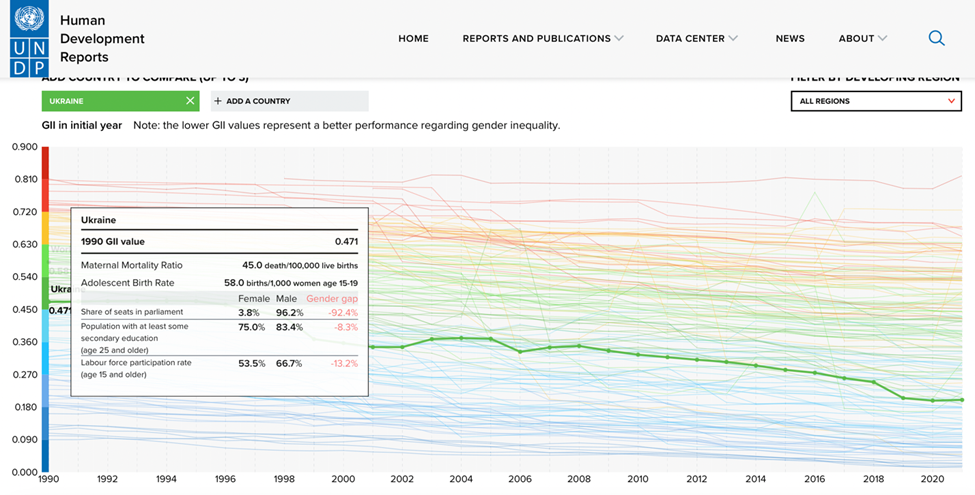
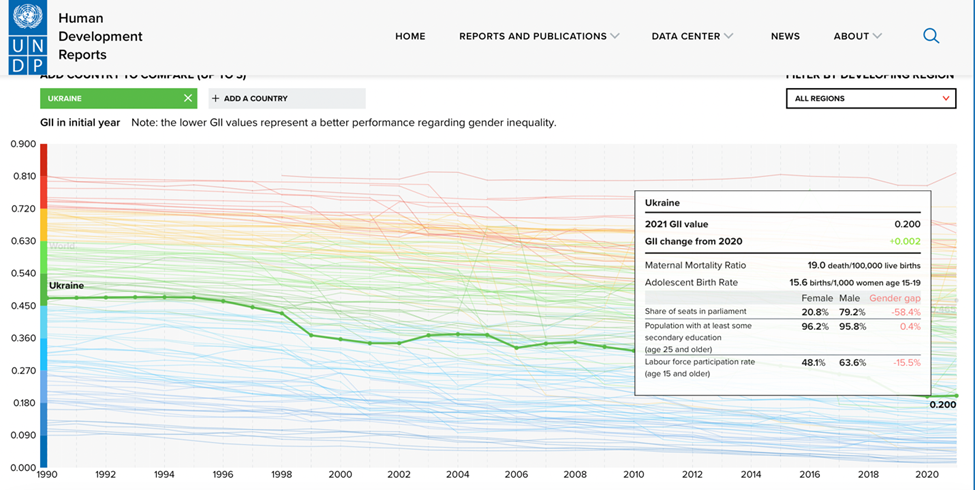
The Gender Inequality Index (GII) that is calculated by the United Nations Development Program (UNDP) is a compound metric that considers reproductive health, women’s empowerment, and women’s participation in the labor market. According to the GII, Ukraine significantly improved its position since the 1990s. For instance, in 1990, maternal mortality ratio was 45 deaths per 100,000 live births — compare with only 19 deaths per 100,000 live births in 2021. In 1990, the GII value awarded to Ukraine was only 0.471, whereas by 2021, Ukraine has significantly improved and achieved the value of 0.200 (the lower the value, the less gender inequality there is in the country).
Political participation of women in Ukraine has also improved over the years. For instance, in 2023, 20.43% of MPs in the Ukrainian Parliament (Verkhovna Rada) are women. According to the Interparliamentary union (an international organization of parliaments that promotes democracy), Ukraine ranks 111th among 194 participating countries. Comparing it to other countries in the region, Ukraine is doing slightly better than Kyrgyzstan (where 20% of MPs are women) and slightly worse than Greece (where 21% of MPs are women). This is a significant change in the last decade given that in 2012, only 10% of MPs in Verkhovna Rada were women and that it took Ukraine almost 20 years to achieve that meagre number.
In the parliamentary elections of 2020, 28% of elected representatives to the regional councils were women and 42% of elected representatives to the village councils were women. Unfortunately, though, the situation with women’s representation in the highest organ of the executive branch, the Cabinet of Ministers, is less promising. Part of the problem may be due to the fact that positions in this institution are handed down by appointment rather than elections. As of 2023, only 5 of the 22 ministers are women (22,7%).
Other important benchmarks in the recent decade were the ratification of the Istanbul Convention in 2022, the adoption of an amendment to a labor code that openly prohibits discrimination based on sexual orientation and gender identity (SOGI) in 2015, and the abolition of the Decree №60 of the Ministry of Health in 2016 that required that transgender people undergo mandatory sterilization and inpatient psychiatric treatment as preconditions for legal gender change. Unfortunately, these three important steps were all taken under indirect pressure from the EU. Yet, those are nevertheless important legislative wins. Moreover, the said labor amendment is one of the most advanced in the whole European region as despite the fact that many states have similar legislation that protects discrimination based on sexual orientation, few explicitly mention gender identity.
However, the full-scale invasion of Ukraine by russia in 2022 created new challenges for the advancement of women’s rights and gender equality. The invasion not only caused widespread disruption to socio-economic activities, damage to infrastructure, and the environment, but also exacerbated gender-specific challenges, leading to heightened inequalities, discrimination, increased vulnerabilities, and a rise in violence against women and girls. As of August 2023, approximately 6.2 million people have left Ukraine, most of them women with children and senior relatives. According to OECD data, in all host countries “at least 70% of adult Ukrainian refugees are women. In some countries, the figures are even higher. In Italy, Poland, Estonia and the United Kingdom, for instance, the share of women among adults exceeds 80%.”
It is also estimated that the majority of more than 5 million of internally displaced people within Ukraine are women. Moreover, out of 17.5 million people who require assistance within the country, 56% are women and girls. Women now also face significant needs in terms of health, employment, shelter, education for their children, and protection from sexual and gender-based violence. The reduction in access to infrastructure and services has also increased women’s unpaid care responsibilities. There is also a rise in unemployment among women. Finally, approximately 60,000 women now serve in the Armed Forces, National Guard, or work in the National Police, including 5,000 women on the front lines.
Given exacerbated gender inequality in Ukraine, it is important that Ukraine includes gender as a guiding principle of its efforts in rebuilding and recovery, especially given the fact that the Lugano Declaration explicitly mentions that “the recovery process has to be inclusive and ensure gender equality.” Unfortunately, though, Ukraine’s National Recovery Plan has been found to include no specific programs responsible for the advancement of gender equality. It is important to monitor the rolling out of recovery and rebuilding initiatives and to ensure that women and marginalized groups are included every step of the way.
Join our mailing list